

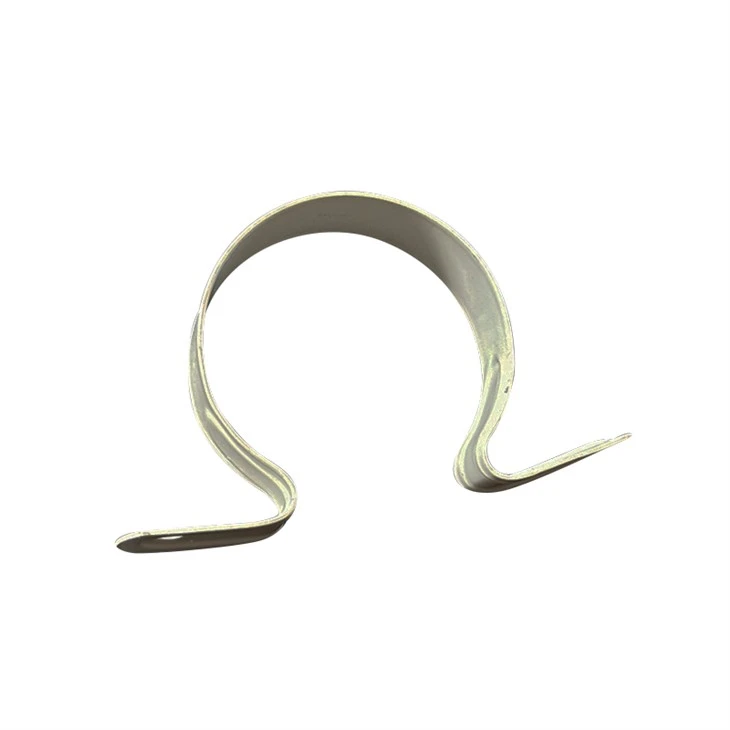
Cangzhou Mengqi Hardware Products Co., Ltd. is one of the leading manufacturers and suppliers of aluminum alloy stamping parts in China. Please feel free to buy cheap aluminum alloy stamping parts made in China here from our factory. All customized products are with high quality and low price.
Raw materials include various specifications of aluminum alloy coils and sheets, including 1060 pure aluminum, 3003 rust-resistant aluminum, 5052 corrosion-resistant aluminum, and 6061 structural aluminum, all available for custom cutting and production. Different grades of aluminum are suitable for different application environments. Pure aluminum has excellent electrical and thermal conductivity, making it suitable for heat dissipation and conductive components. 3003 aluminum has inherent rust-resistant properties, eliminating the need for frequent protective treatments in humid, outdoor environments. 5052 and 6061 aluminum offer higher strength and are preferred for bending, load-bearing supports, and equipment housings. Material certificates are checked upon receiving materials to differentiate between soft and hard aluminum materials, preventing batch defects such as cracking and excessive springback during stamping.
The entire stamping process is mature and stable, employing continuous multi-station dies for one-time forming, reducing surface scratches and dents caused by semi-finished product transfer. Addressing the softness of aluminum alloys and their susceptibility to burrs and indentations, we have specially polished and optimized the die edges and forming cavities, resulting in smooth edges after stamping with virtually no sharp flash, eliminating the need for additional manual grinding and trimming. Dimensional tolerances can be stably controlled within ±0.02~±0.06mm, with uniform hole diameters, bending angles, and flatness, allowing customers to assemble directly upon receipt without on-site corrections, significantly improving assembly efficiency
Compared to traditional steel sheet stamping, aluminum alloy stamping exhibits significant differences in forming characteristics, requiring more precise process control: High springback and difficulty in precision control: Aluminum's elastic modulus is only 1/3 that of steel, resulting in approximately three times the springback of stamped parts. To avoid dimensional deviations, mold design must fully consider springback compensation and minimize secondary forming.
Severe tendency to wrinkle and crack: Aluminum alloys have lower ductility (total elongation approximately 25%) than low-carbon steel (greater than 40%), resulting in a narrower process window between wrinkling and cracking. Optimization of blank holder and draw bead design is necessary to balance material flow
Mold wear and galling: The oxide layer on the aluminum sheet surface easily peels off during friction and adheres to the mold surface, leading to accelerated mold wear or rough part surfaces. This is typically addressed by surface chrome plating, optimized lubrication mechanisms, or the use of non-stick coatings.
Edge binding and trimming defects: Aluminum parts are prone to cracking or developing "orange peel" defects during edge binding, and roller edge binding is generally recommended. Trimming easily produces large burrs and debris, requiring extremely precise cutting edge clearance and trimming angles.
If you have specific needs for aluminum alloy stamping parts, please tell me the application scenario, approximate dimensions, precision requirements, and desired aluminum alloy grade. I can then further assess the processing difficulty and process plan for you.
Hot Tags: aluminum alloy stamping parts, China aluminum alloy stamping parts manufacturers, suppliers, factory, Cnc Machining Automotive Parts, Cnc Machining Precision Parts, Cnc Precision Components, Cnc Precision Turned Parts, Cnc Turning Milling Parts, precision cnc machined parts


